Loveland Car Accident Lawyer Guide: First Steps, Crash Reports and Colorado Law
Last updated
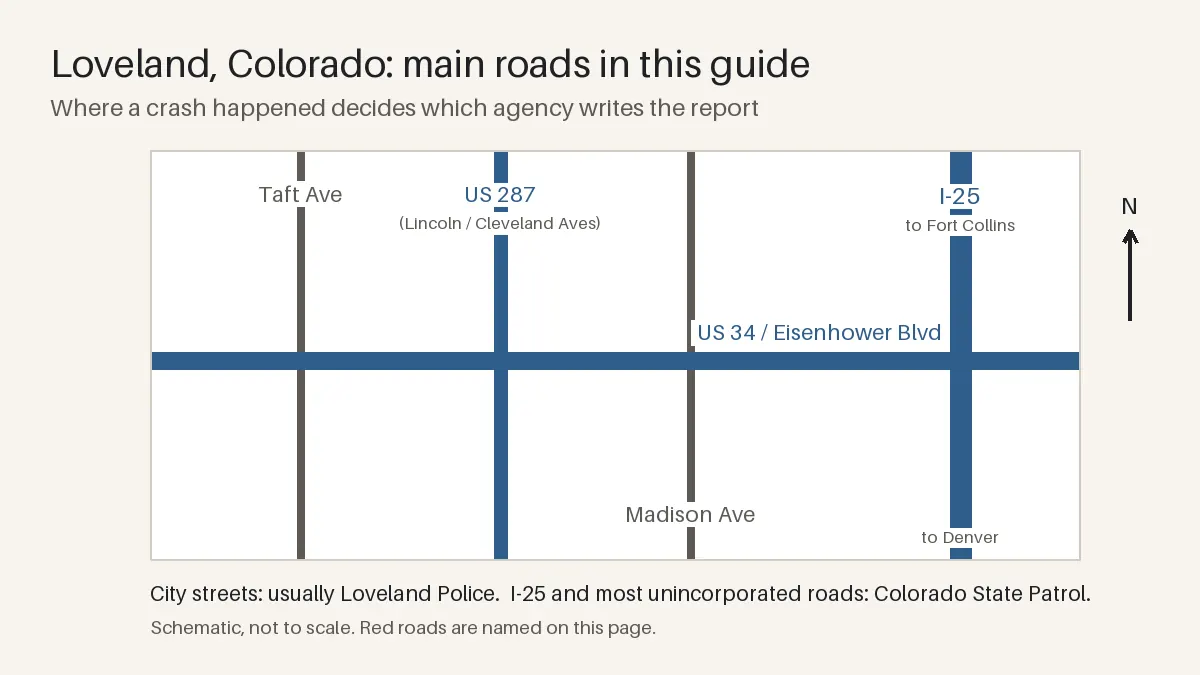
Most people never plan for a wreck on a busy stretch of US 287 through town, or for a sudden slowdown on US 34 heading toward the interstate. When it happens, a short checklist is more useful than a long search. This guide covers the scene, the report, the state rules behind any claim, and a careful way to compare lawyers.
It is written as general information, based on Colorado statutes and the public pages of the agencies involved. Procedures and fees can be updated without notice, so treat each linked source as the final word.
First Steps After a Loveland Collision
Several of the steps below are not just good practice. Colorado statutes require them, and skipping one can create problems of its own.
Before you leave the scene
- Pull over at the crash site, or as near as safety allows, and stay. Under C.R.S. 42-4-1601, a driver who leaves a collision involving injury commits an offense that becomes a felony when the harm is serious or fatal.
- If a vehicle is still drivable and you are on a divided highway like I-25, C.R.S. 42-4-1602(2) says to move it off the travel lanes promptly. Call 911 when someone is injured or the scene is dangerous.
- Help an injured person where it is practical, for example by getting them to medical care; C.R.S. 42-4-1603 makes that a duty.
- Trade names, addresses and registration numbers, and display your driver's license on request. Swap insurance information too.
- Notify the police without delay. C.R.S. 42-4-1606 requires an immediate report for any collision with injury, death or property damage of any amount.
- Photograph the scene from several angles: damage, license plates, traffic lights, road conditions and injuries. Note contact details for anyone who saw it happen.
Over the next few days
- Get checked by a medical provider within a day or two, because pain from whiplash or a head injury can appear late.
- Tell your insurance company about the crash quickly and describe what happened without speculating about blame.
- Save every receipt, estimate and medical bill, and keep a simple log of symptoms and missed work.
Those records matter more than most people expect. An adjuster weighing your claim will look for a clear line from the collision to each expense, and gaps in treatment or missing receipts are often used to argue that a cost was unrelated.
Obtaining Your Loveland Crash Report
Ask the officer at the scene for the report or case number and keep it with your notes. Without it, any records request will be slow, and the agency may need extra details to locate the file.
Who wrote the report
- Inside city limits, collisions are generally investigated by the Loveland Police Department, whose records release follows state law and department policy.
- On I-25 and on many roads outside town, the responding agency is often the Colorado State Patrol; see its crash information page.
- According to the Larimer County Sheriff's Office, deputies are the primary reporting agency for crashes only in Wellington and Berthoud.
Requesting your copy
Each agency sets its own timing and charges, and those details shift, so read the current page before submitting anything.
- The State Patrol uses an online records portal and needs the driver name, date, case number and location of the crash.
- State crash records, including many self-reported minor collisions, are handled through the Colorado DMV crash records page.
- Loveland Police processes requests submitted on its records form, typically in three to five business days, and its minor crash page points drivers with no injuries needing medical care to the DMV's online reporting option, subject to eligibility criteria.
Colorado Laws That Shape a Claim
Colorado uses a fault-based system. The state's no-fault law ended in 2003, so the person who caused the collision, usually through their insurer, is generally the one who pays for resulting harm.
Coverage Colorado requires
- Minimum liability limits under C.R.S. 10-4-620 are $25,000 per injured person, $50,000 per accident for all injuries, and $15,000 for property damage.
- Uninsured and underinsured motorist coverage must be included under C.R.S. 10-4-609 unless the named insured turns it down in writing. It helps when the other driver has no insurance or not enough.
- C.R.S. 10-4-635 adds $5,000 in medical payments coverage by default, which the named insured may reject in writing.
- Consumer resources on auto policies and insurer complaints are available from the Colorado Division of Insurance.
When both drivers share blame
Fault can be split. Under C.R.S. 13-21-111, a claimant who is partly to blame has the award cut by that percentage. A claimant at 50 percent or more, so not less at fault than the other side, is barred from recovering at all.
Time limits
- Personal injury and property damage suits arising from operating a motor vehicle: three years, C.R.S. 13-80-101(1)(n)(I).
- Wrongful death actions: generally two years, C.R.S. 13-80-102(1)(d).
- Claims against a public entity, such as a crash with a government vehicle: written notice within 182 days after the injury is discovered, C.R.S. 24-10-109. Without timely notice, the claim is barred.
- Exceptions exist, including for injured children, so verify the dates that apply to you.
The full text of each section is in the official Colorado Revised Statutes.
Choosing a Car Accident Lawyer Carefully
Plenty of minor fender benders settle directly with an insurer. Hiring help becomes more common with serious injuries, contested fault, an uninsured driver, or a public entity claim with its short notice window.
Basic checks
- Look up any lawyer in the Colorado attorney search, maintained by the Office of Attorney Regulation Counsel for the Colorado Supreme Court. You want an active status in good standing, and any public discipline appears there.
- Ask about experience with car crash claims specifically and about the lawyer's own trial record.
- Expect a signed written agreement for a contingency fee. The rules once found in C.R.C.P. Chapter 23.3 were moved into Colorado Rule of Professional Conduct 1.5(c), which requires the client and the lawyer to sign.
- Make sure the agreement spells out the percentage, how expenses are handled relative to the fee, and your obligation for costs if the case is lost.
What to ask at the first meeting
- Will you personally work on my case, or will someone else manage it most days?
- How will you keep me informed, and how fast should I expect answers?
- Which facts help my claim most, and which ones worry you?
- What expenses might come up, and who pays them along the way?
- How will settlement decisions be made, and who has the final say?
Warning signs
- A stranger reaching out shortly after your crash. Under C.R.S. 13-93-111, soliciting an injured person in person, by phone or in writing within 30 days is prohibited absent a request or prior relationship, and the injured person may cancel any agreement signed as a result.
- A guaranteed outcome or a confident dollar figure at the first meeting.
- Vague answers about fees or a refusal to write them down.
Final Thoughts
A crash in Loveland sets several clocks running at once, from the duty to report to the three-year filing limit and the much shorter public entity notice. Taking the steps in order and checking any lawyer carefully keeps your options open. For advice that fits your own circumstances, consult a licensed Colorado attorney you select yourself.